
Confirmed Rockledge City Directory Collections and Access
Central Brevard Library and Reference Center in Cocoa holds the two most useful directory series for Rockledge. The Polk volumes are filed under a Cocoa-area title that explicitly includes Rockledge, Cocoa Beach and Merritt Island. Hill-Donnelly covers the county and reverses the search direction. State and federal collections extend the timeline but should not be represented as confirmed Rockledge directory volumes.
| Collection | Years | Where Held | Access |
|---|---|---|---|
| Polk Cocoa-area city directories including Rockledge | 1958-1993; 1995-1999, with a 1999 inventory conflict | Central Brevard Library | Reference shelf; call to confirm a volume |
| Hill-Donnelly Brevard criss-cross | 1969-1985; 1987-1989; 1991-1999; 2001-2002; 2004-2006 | Central Brevard Library | Search by address or phone, not name |
| Florida city directories | Early 1900s to present across Florida | State Library, Tallahassee | Onsite or reference help; verify catalog scope |
| Federal census | 1790-1950 currently public | NARA, official partners and library databases | Name, household and enumeration research |
| Florida state census | Surviving schedules through 1945 | State Archives and Florida Memory | Catalog and selected digitized records |
Publication of the local Polk run ceased. The official library sheet gives an ending year of 1999 but also labels 1999 missing, so the safe practice is to telephone the shelf for volume-level confirmation. Other branches may have further gaps.
Ask for the exact publisher and year, not merely “an old phone book.” A shelf check can confirm whether the book is present, whether Rockledge falls within its geographic scope, and whether the useful section is alphabetical or arranged by street. Note the title page and coverage statement with any entry copied.
Why Rockledge City Directories Hide Under “Cocoa”
A catalog search for a standalone Rockledge title can miss the strongest confirmed collection. Polk grouped Rockledge within its Cocoa-area city directory run. That regional filing fits central mainland Brevard, where local records and institutions often connect Rockledge with Cocoa, Merritt Island, Viera and Melbourne.
Search a regional title, then read the scope note before deciding that Rockledge is absent. This small catalog quirk saves wasted searches and keeps the evidence tied to the correct edition. It also explains why a countywide Hill-Donnelly book may be more useful than a presumed city-only telephone volume.
The regional approach also fits family trails that cross short distances within central Brevard. A person may keep work, church, school, newspaper, or property ties in an adjacent place while remaining listed at a Rockledge address. Preserve the city printed in the source rather than silently normalizing it.
The successful image below comes from the official State Library city directories page and illustrates the statewide catalog and research route.
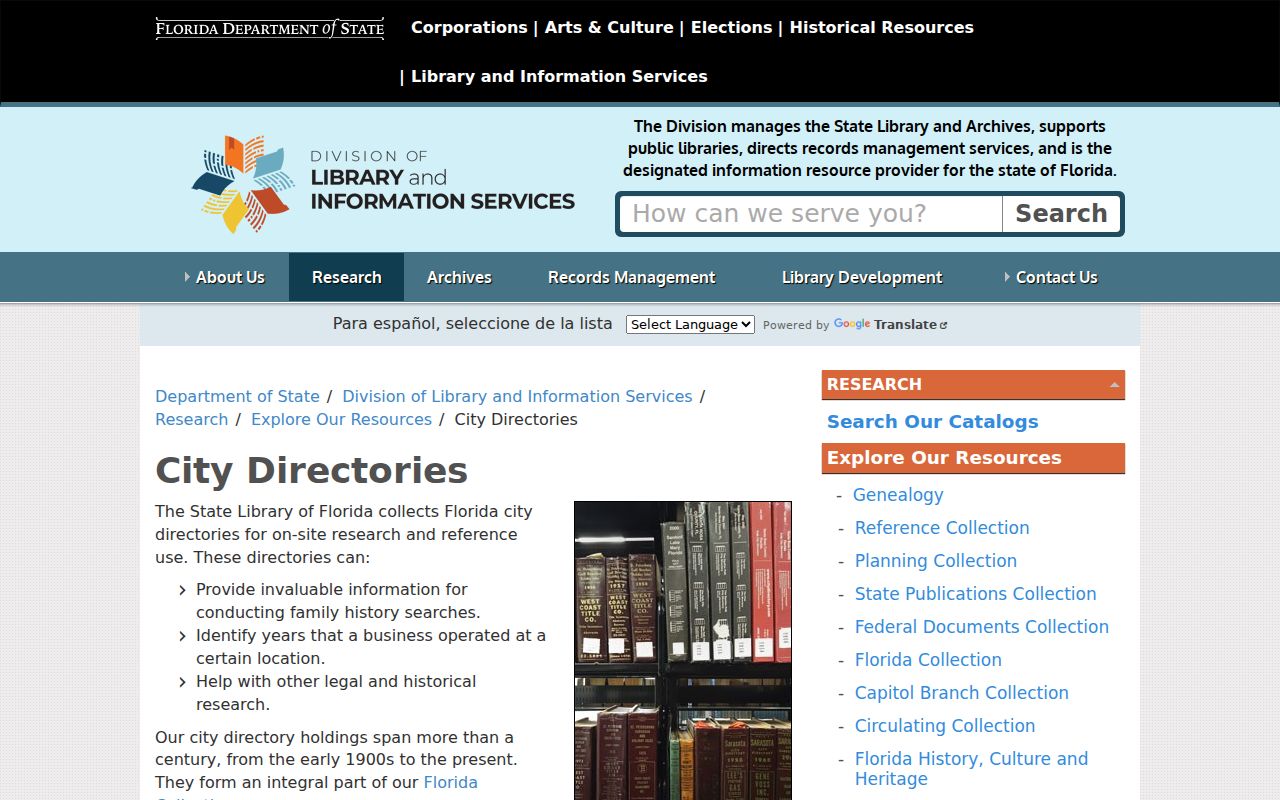
Use the State Library as a catalog and reference fallback, but verify that any result truly includes Rockledge before citing it.
Use Brevard's Hill-Donnelly Run as a Reverse Directory
Hill-Donnelly volumes answer a different question from Polk. They are organized for address or telephone searches, not by a person's name. Find the street alphabetically, scan house numbers in sequence, record the subscriber and phone, and check nearby numbers if the purpose is block or neighbor history.
The confirmed run has gaps. It covers 1969 through 1985, 1987 through 1989, 1991 through 1999, 2001, 2002, and 2004 through 2006. A missing listing can reflect a missing book, an unlisted or mobile subscriber, a renter-versus-subscriber difference, or a postal change. It is not proof that the household left Rockledge.
How to Read a Rockledge City Directory Entry
The holdings inventory is not a scanned resident page, so the exact marks must be checked in the chosen volume. A typical Polk entry may provide a surname, given name or initial, spouse notation, occupation, employer, home address, telephone, or a home-status mark. Photograph or transcribe the edition's own abbreviation key before interpreting any line.
| Name | Surname and given name or initial; spouse may appear in parentheses |
|---|---|
| Occupation | Trade or role and sometimes an employer, depending on edition |
| Address | House number and street, with edition-specific residence marks |
| Home status | Some editions use a symbol for owner or renter; verify the key |
| Widow notation | A “wid” entry may name a deceased spouse and supply a family clue |
- Criss-cross directory
- An address-or-phone arrangement that reverses the usual name-first lookup.
- Householder index
- A name or address guide to the principal listed subscriber, not every person at the home.
- Abbreviation key
- The edition's guide to marks such as home, residence, employed and widow notation.
Cross-check the alphabetical entry against the street guide. A city directory entry is evidence from one publication cycle, not a certified statement of family relationship or continuous occupancy.
Initials and spouse notations can distinguish two similar names, but they are not enough by themselves. Compare occupation, address progression, deed parties, obituary relatives, and census household members. Married surname changes and compound names deserve variant searches in the next and prior volume.
The Rockledge Directory Timeline Has Three Clear Seams
The local record timeline is useful because each seam changes the best research tool. Before the confirmed directory shelf begins, deeds, censuses, tax records, newspapers and institutional registers do more of the work. The Polk and Hill-Donnelly periods then provide regular address clues, followed by today's split digital systems.
| Period | Key Rockledge evidence | Research consequence |
|---|---|---|
| Before 1958 | No confirmed local Polk volume in the inventory | Lead with deeds, census, voter, tax, church, cemetery and newspapers |
| 1958-1990s | Polk Cocoa-area run includes Rockledge | Trace a name, spouse, work clue and address by edition |
| 1969-2006 with gaps | Hill-Donnelly county reverse books | Begin with address or phone and scan house-number order |
| 1981 forward | Clerk Acclaim online official-record index | Link directory clues to recorded deeds and legal descriptions |
Older instruments before the Clerk's online cutoff are not presumed lost. They move to clerk research, books, office records, microfilm and archival catalogs. No verified courthouse-fire story supports a different conclusion.
Digital sources now divide the task among BCPAO parcel data, Clerk recorded documents, Rockledge permit files and election records. That division makes a source log vital. Write down which system supplied each name and address, its date, and whether the item was an index, image, catalog description, or physical volume.
Pair Rockledge City Directories with Census Snapshots
The 1950 federal census is public in 2026, while the 1960 census is scheduled to open in 2032 under the 72-year rule. A census records a household on its enumeration date. A directory reflects a survey and publication cycle that can lag. Dates that nearly match should still be cited separately.
Florida's state census ended after 1945, which makes the federal census the main systematic household snapshot from 1950 onward. For earlier county presence, State Archives materials include Reconstruction voter rolls from 1867 and 1868 with name, race, residence duration, nativity or naturalization evidence.
The official Florida historical census and voter-record guide is shown below.
Record the series, year and field that supports each conclusion rather than merging all sources into one undated household claim.
Extend a Rockledge City Directory Search Through Archives
The State Archives Genealogical Collection adds family and local histories, immigration lists, church and cemetery material, military records, journals, Bible records and family-name files. Its catalog is descriptive, so email or telephone reference staff for targeted series and copies. Florida Memory adds selected government records and historic photographs.
The Brevard Historical Commission's Indian River Journal, county histories, landmark guides and local photographs can add neighborhood context. Brevard library newspaper databases and microfilm, including Florida Today and predecessors, may supply obituaries, weddings, school or community notices. Coverage varies, so save title, date and page.
This successful image comes from the official Florida State Archives page and shows the catalog and reference gateway.
Church, funeral-home and cemetery sources can bridge gaps, but their relationship claims should be checked against certificates, probate or recorded property.
FamilySearch can also be searched by Brevard County and record type for deed, probate and marriage material, though images may require a free account or a FamilySearch Center. Exact collection access was not verified in the research, so use its catalog as a lead and confirm the original keeper before relying on a result.
Trace a Family Through Rockledge City Directories
A careful family-history trail begins with one known name, year or address and moves in small, documented steps. Spelling variants, initials, suffixes and surname changes matter. So do directory gaps and regional catalog labels. Treat every appearance as a dated clue to be tested against an independent record.
- Choose the nearest confirmed Polk year and search every reasonable name form.
- Move volume by volume, recording first and last appearance, spouse, address and work clues.
- Use Hill-Donnelly by address in its covered years to test the subscriber and nearby house numbers.
- Compare the directory evidence with the public census, deeds, probate and newspapers, keeping each date distinct.
- For a disappearance, test death, move, publication gap, unlisted phone and name-change explanations before concluding.
Before 1958, shift the lead source to deeds, tax rolls, censuses, voter records, marriage or probate files, newspapers, and church or cemetery registers. After a directory find, modern verification should use the official source that matches the fact. The Rockledge resident lookup page explains that one-person verification path.